
Urology
Ureteroscope Repair for Flexible Urology Scopes
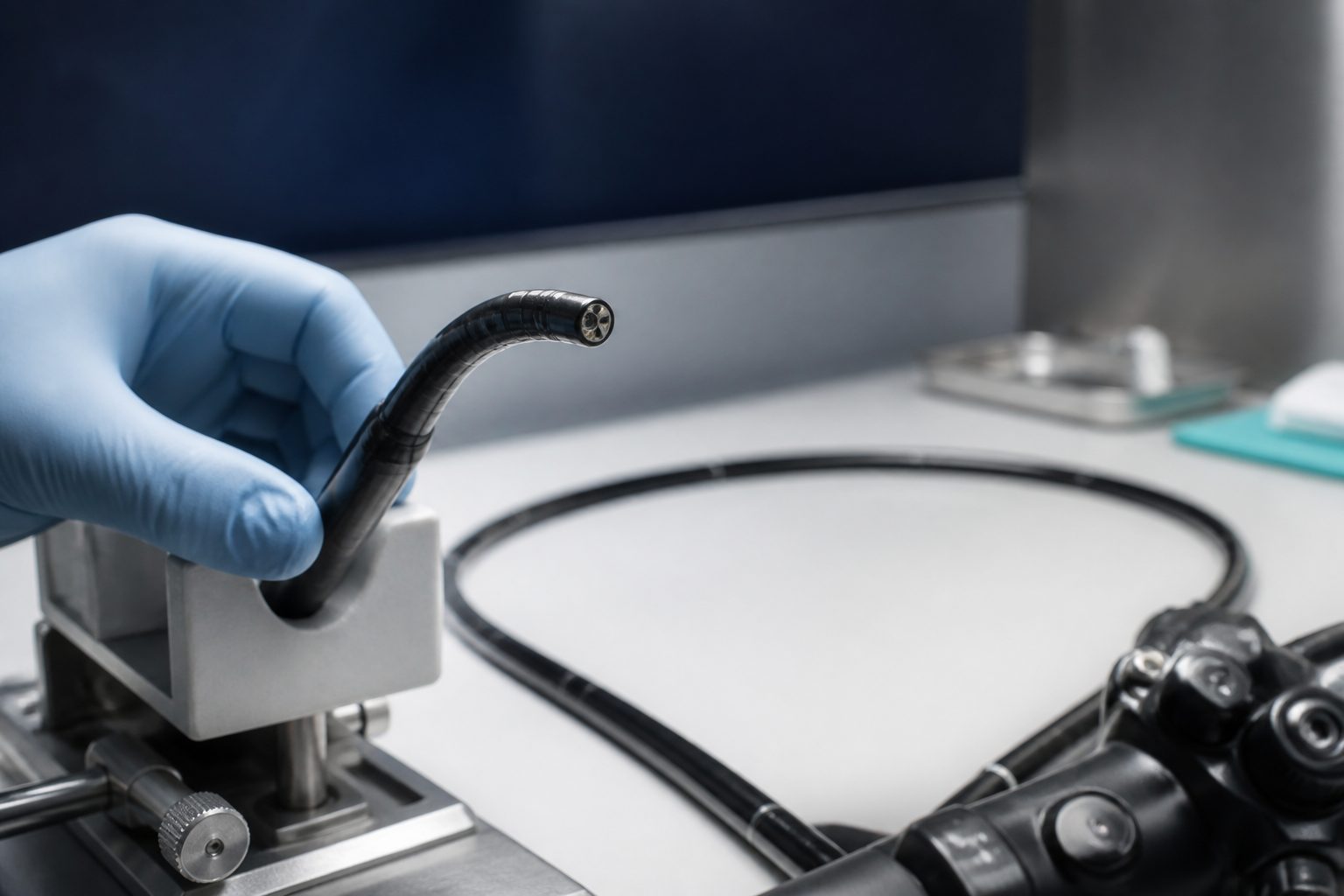
Flexible ureteroscopes fail faster than anything else in urology, and most of that damage happens inside the working channel. We recover deflection, replace liners, and repair optics, with a written quote before any work.
- Active and secondary deflection recovery
- Working channel liner replacement
- Laser burn and perforation repair
- Distal optics and image bundle work
Get a Free Repair Quote
Tell us what failed and we will send a written quote before any work begins. No charge for the evaluation, and no purchase order needed to get one.
Quote before any work
You approve a written quote before a technician touches the scope.
Free evaluation
We diagnose the failure and price the repair at no charge, even if you decline.
We come and get it
Pickup and delivery across Southern California, mail-in service everywhere else.
Independent, not the OEM
All major manufacturers serviced, without OEM exchange pricing.
By symptom
Ureteroscope Failures We See From Urology Services
Most of these start during a case rather than in reprocessing. Match what you are seeing and call with the model number.
Stretched deflection wires
Working against a stone in a lower pole calyx loads the deflection wires harder than any other maneuver in urology. Travel falls short of the model range and the tip lags the lever. Wires are replaced and tension is reset.
Loss of deflection under accessory load
A scope can hit full travel empty and lose thirty degrees with a laser fiber or basket in the channel. That is a wire and channel condition, not a technique problem, and it is measured with the accessory in place.
Laser burn through the channel wall
A fiber fired inside the channel, or advanced with the tip deflected, burns through the liner and out through the shaft. It is the single most expensive habit in flexible ureteroscopy. Liner and shaft repair follow.
Scored working channel liner
Baskets, fibers, and stone fragments cut the liner along the deflected bend where pressure is highest. Once the surface is grooved, every subsequent pass cuts deeper. Liner replacement is the only durable fix.
Broken image bundle fibers
On a fiberoptic ureteroscope each broken fiber prints a permanent black dot. They accumulate with every hard deflection cycle until the field is unusable. Bundle repair or replacement restores the view.
Access sheath and insertion damage
Repeated passes through an access sheath, especially a tight or kinked one, abrade and deform the shaft. Deformation binds the internal wires and channel, so deflection and flow degrade together.
Why Ureteroscope Deflection Is the First Thing to Go
Flexible ureteroscopy asks a single device to bend further, more often, and under more load than any other flexible scope in the building. Reaching a lower pole calyx means near maximum active deflection, then holding it while a laser fiber or a basket passes through a channel that runs along the outside of that bend. Every one of those cases takes something out of the wires.
The result is a device that measures fine empty and fails in the case. That is why we measure deflection twice, once with the channel clear and once with an accessory loaded, because the second number is the one that decides whether your urologist can reach the stone. A scope that loses meaningful travel under load needs wire replacement, not adjustment.
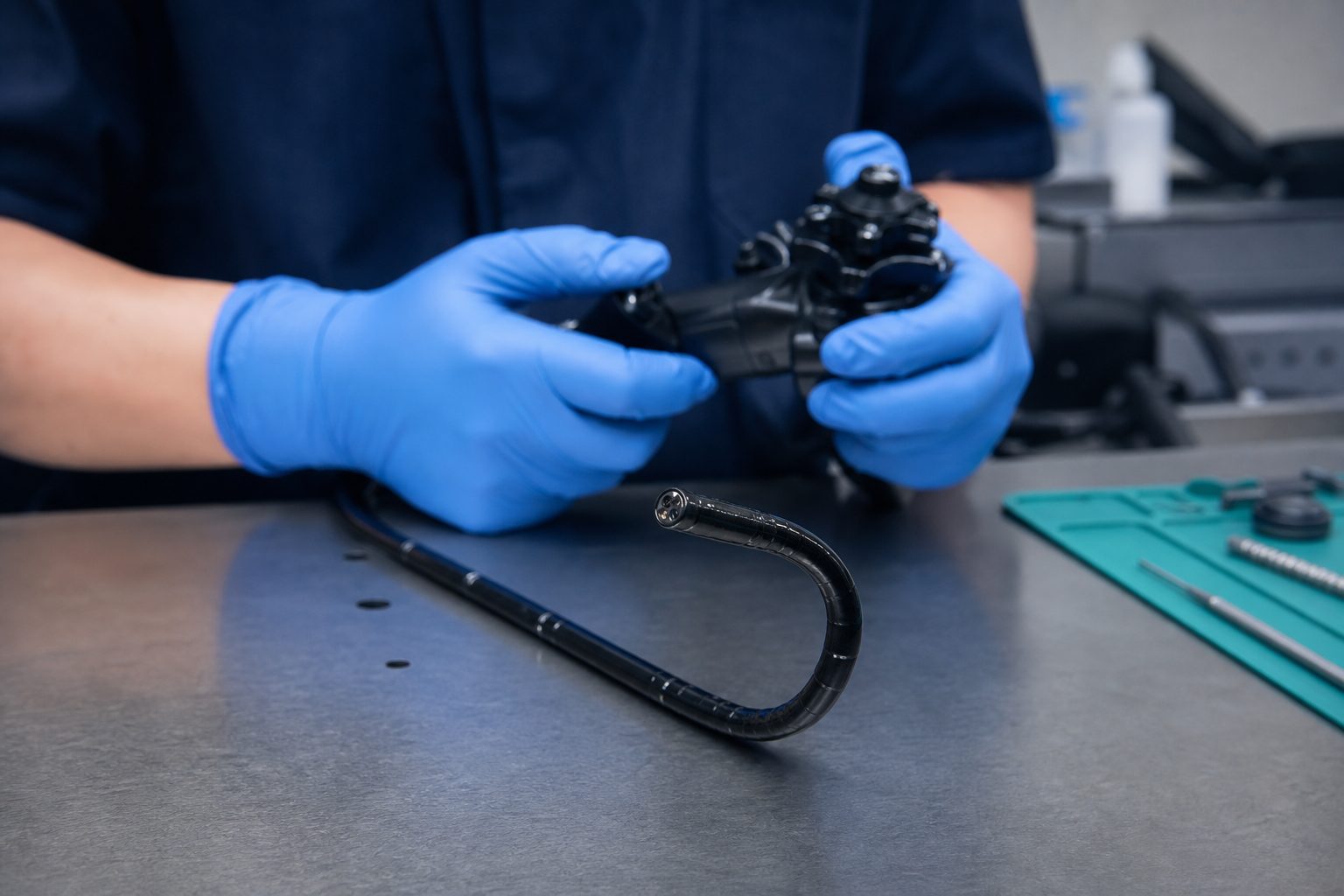
The mechanics are the same as any other angulation and steering cable repair, with much less tolerance for error, and every scope goes through the same intake as the rest of our flexible endoscope repair work.
Laser Fiber Damage Inside the Working Channel
One habit accounts for more scrapped urology scopes than everything else combined. A holmium fiber fired before it clears the tip, or advanced while the scope is deflected, burns straight through the channel liner and often out through the shaft. It takes a fraction of a second and it is not always noticed during the case.
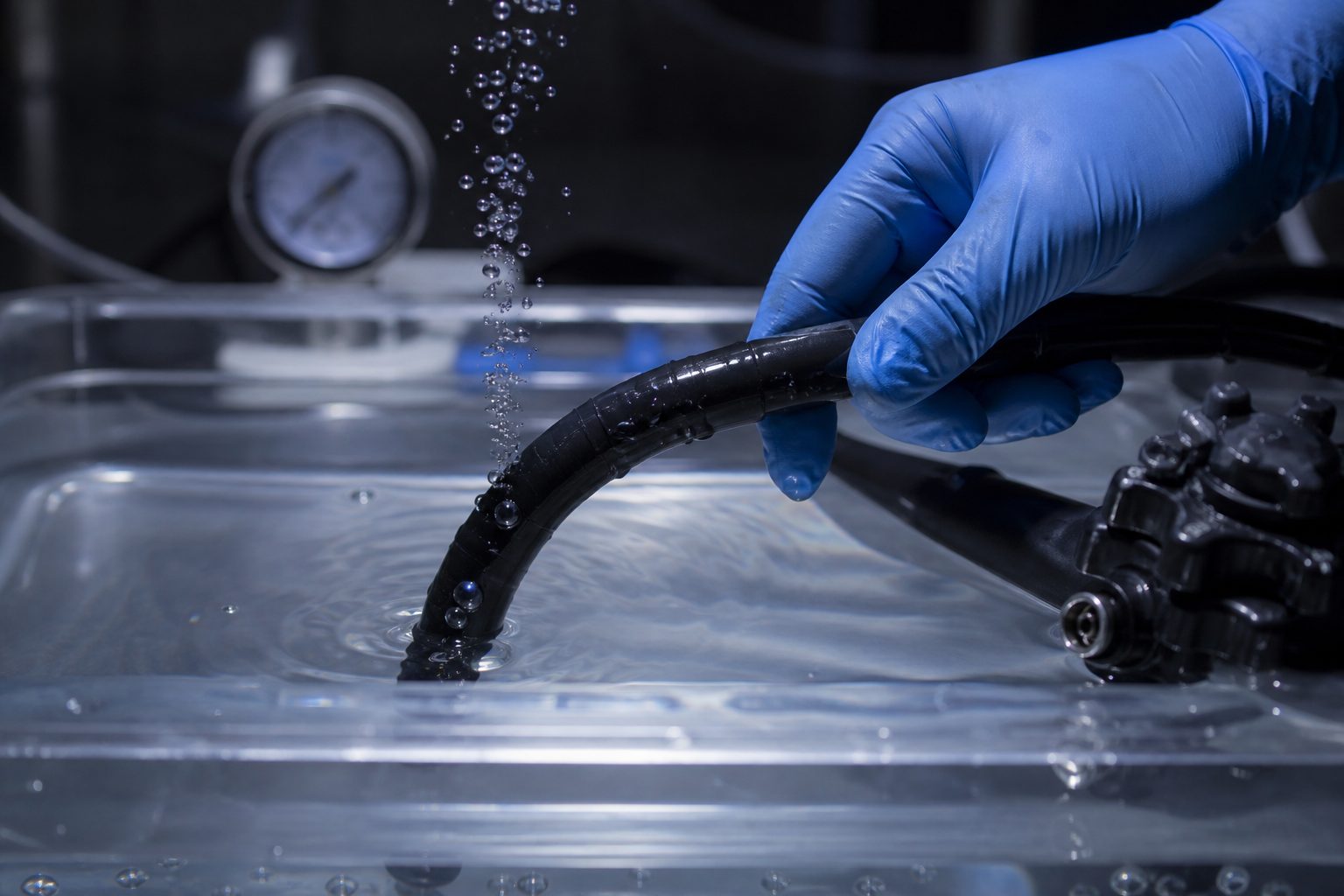
What follows is a scope that leaks irrigation into its own body, loses deflection because the burn path crosses the wire run, and fails a leak test at the next reprocessing cycle. Catching it in the OR is worth more than any repair we can perform afterward. If a device has already taken fluid internally, our fluid invasion recovery page covers what is still salvageable.
When the liner is the only casualty, replacement puts the scope back in rotation. The same repair covers accessory scoring from baskets and stone fragments, described on our working channel and port page.
Access Sheaths and Flexible Ureteroscope Shaft Wear
Access sheaths protect the ureter and they abrade the scope. Every pass drags the shaft against the inner wall of the sheath, and a sheath that has kinked or that is undersized for the scope turns that abrasion into deformation. An ovalized shaft binds the wires and the channel inside it, so deflection and irrigation flow decline at the same time.
That combination is frequently reported as two separate problems on two separate service tags. It is one. We inspect shaft geometry rather than only the surface, because a scope that looks scuffed and a scope that is out of round need different work. Devices with visible crush or kink damage are covered on our bent insertion tube page.
Most of these scopes arrive with an Olympus urology nameplate or a Karl Storz label. We are an independent provider and are not affiliated with or authorized by either.
Urology Scope Damage That Happens Before the Case Ends
Unlike GI scopes, most ureteroscope damage is intraoperative. The burn, the crush against a sheath, the fiber that scored the liner on the way out, all of it happens with the device in a sterile field where nobody is going to stop and inspect it. Reprocessing then finds a leak and gets blamed for a fault it inherited.
That changes what a repair report is worth. We document where the damage started, not just what it costs to fix, because a department that learns its scopes are failing at the same point in the same procedure can change something. A department that only receives an invoice cannot.
Urology services usually share a decontamination room with other flexible fleets, so one pickup often carries a bronchoscope with a scored channel or a flexible sigmoidoscope that has been sitting unused. One account, one point of contact, one condition report per scope.
How it works
How Ureteroscope Service Runs From Intake to Return
A free evaluation, an itemized written quote, and no work until your department authorizes it.
Tell us what failed
Send the manufacturer, model, and what you are seeing. A photo of the damage helps but is not required.
We collect the scope
Courier pickup across Southern California, or ship the device in to our bench from anywhere in the country.
You get a written quote
We evaluate the device, document the failure, and price the repair. Nothing proceeds until you approve it.
Repaired, tested, returned
The device is repaired, leak and function tested, and returned with documentation for your records.
Questions we get
Ureteroscope Repair Questions From OR and SPD Teams
The scope deflects fully until we load a laser fiber. Is that repairable?
A fiber was fired inside the channel. Is the scope finished?
We are seeing black dots in the image. What causes those?
How quickly should a leaking ureteroscope come out of service?
Do you pick up, or do we ship?
More Flexible Scope Repair Across Specialties
The same bench handles the rest of the flexible fleet in your building.
Free Evaluation Before Any Ureteroscope Service
Send the manufacturer, the model, and what happened during the case. You get the diagnosis and the price before anything is opened.
Monday to Friday, 8:00 AM to 5:00 PM Pacific
Saturday and Sunday, closed
Mail-in repairs received any day
Serving Southern California with pickup and delivery, and the rest of the country by mail-in.