
Bench protocol
Our Endoscope Repair Process, From Intake to Documented Return
This is the sequence every device goes through, in order, from the moment it reaches us to the moment it goes back on your shelf. It is written for the people who have to approve a vendor rather than for the people who buy one.
- Documented intake before anything is opened
- Leak and pressure testing on arrival
- Function verification before the device ships
- Written record returned with every device
Get a Free Repair Quote
Tell us what failed and we will send a written quote before any work begins. No charge for the evaluation, and no purchase order needed to get one.
Step by step
The Scope Repair Protocol We Follow on Every Device
Eight steps, in this order, whether the device is a video colonoscope or a rigid telescope from a legacy set.
-
1
Intake, identification, and photographic record
The device is logged against your facility, the manufacturer and model are recorded from the label, and the serial number is captured so the unit you sent is the unit you get back. We photograph the condition on arrival, including any damage visible before anything is opened, and record the symptom exactly as your department described it.
-
2
Leak and pressure testing on arrival
Flexible devices are pressure tested before any other handling. This establishes whether the outer seal is intact and, when it is not, roughly where the breach sits. Testing on arrival matters because it separates damage that came from the case from damage that could have been introduced in transit or during the last reprocessing cycle.
-
3
Functional assessment while the device is still closed
Before disassembly we check articulation through the full deflection range, channel patency across air, water, suction, and biopsy paths, and image quality through the optics. Rigid devices get an optical inspection through the relay, a check of the eyepiece and light post seals, and a shaft straightness assessment. Everything found is written down.
-
4
Disassembly and internal inspection
The device is opened only as far as the diagnosis requires. Bending sections, control bodies, distal caps, and eyepieces are accessed by the sequence that platform requires, since forcing the wrong step turns a contained repair into a larger one. Internal corrosion, fluid staining, wire condition, and channel liner wear are all recorded at this stage.
-
5
Written quote, then the repair itself
Nothing is repaired until you have an itemized quote and have approved it. Once approved, the work is done to the fault found: channel liner replacement, angulation wire and steering hardware service, bending rubber replacement, distal lens and objective work, illumination bundle repair, rod lens replacement, or seal restoration, depending on the device.
-
6
Reassembly and seal restoration
The device is rebuilt in the reverse of the disassembly sequence, with every seal, gasket, and O-ring in the disturbed path replaced rather than reused. On autoclavable rigid telescopes this step decides whether the device survives sterilization, so the seals are restored to the condition the platform requires rather than to whatever still looks intact.
-
7
Function and leak verification after the repair
The device is pressure tested again after reassembly, and the full functional assessment is repeated: deflection through the complete range, channel flow across every path, image quality through the optics, and valve and port seating. A repair is not finished when the fault is fixed. It is finished when the device passes the same tests it failed on arrival.
-
8
Final quality check and documented return
A second set of eyes checks the device against the intake record, confirms the serial number matches, and confirms the reported symptom is gone. The device is packed for transit and returned by courier or carrier with a written record of what was found, what was done, and what testing it passed.
Why the Repair Process Matters More Than the Price
Two shops can quote the same number for the same fault and hand back two very different devices. The difference is almost never the part. It is whether anyone verified the repair against the failure, and whether anyone looked at the rest of the device while it was open.
A scope that comes back with the reported symptom fixed and a partly worn channel liner nobody mentioned is a scope that returns in a few months. We write down what we find even when you did not ask about it and even when you decline the extra work, so the next failure is not a surprise.
That is also why the evaluation is free. Pricing a repair from a phone description is a guess, and a guess has to be revised once the device is open. You can see the equipment this applies to on the repair services overview.
Testing Before and After Every Endoscope Repair
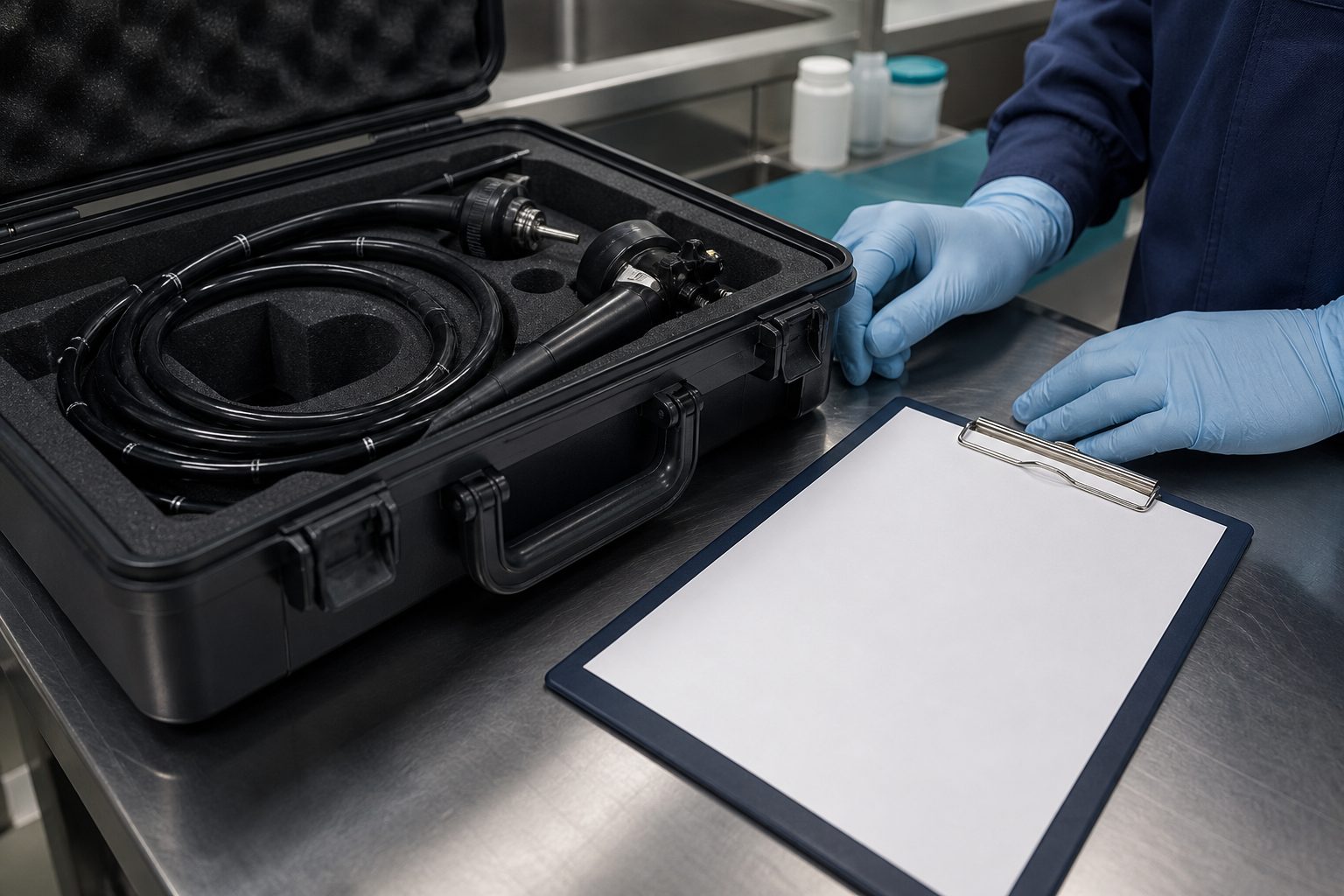
Pressure testing happens twice, on arrival and after reassembly, and the two results are compared. That comparison is the honest measure of a repair. A device that passes on the way out but was never tested on the way in tells you nothing about what was actually fixed.
The same applies to function. Deflection is measured through the full range rather than checked for movement, channels are flowed rather than eyeballed, and optics are assessed through the relay rather than by holding the device up to a window. The device specific tests are listed under flexible endoscope service.
If the device came to you from a failed reprocessing test, the sequence on the leak testing and leak repair page explains what we look for and why the timing of that first failure matters so much.
What Comes Back With Your Repaired Medical Scope
Every device returns with a written record: the condition on arrival, the fault found, the work performed, the parts and seals replaced, and the tests it passed before it shipped. That document is what your biomed department files against the asset, and it is what makes the next repair on the same device readable rather than mysterious.
If your facility keeps records in a particular format, say so before the repair starts and we will match it. It is easier to write the record the way you need it than to reconstruct it later.
The device also comes back as the device you sent. Serial numbers are checked at intake and again at final inspection, which is a distinction worth naming when the alternative on the market is an exchange program. The reasoning behind that is on our page about how the business runs.
Questions we get
Questions Biomed Teams Ask About Our Repair Process
Do you pressure test flexible devices before you open them?
What documentation comes back with the device?
Do you replace seals and gaskets, or only the failed component?
Will you tell us about problems we did not ask about?
How do we know the device we get back is the one we sent?
Start a Scope Repair and See the Documentation
Send one device and read what comes back with it. That tells you more about a vendor than any brochure will.
Monday to Friday, 8:00 AM to 5:00 PM Pacific
Saturday and Sunday, closed
Mail-in repairs received any day
Serving Southern California with pickup and delivery, and the rest of the country by mail-in.