
Los Angeles County
Endoscope Repair: Los Angeles County Coverage for Multi-Site Systems
One agreement covers every site you run in Los Angeles County, from the Valley to the South Bay. Devices from several campuses travel on the same collection, and each one is evaluated free and quoted in writing before work starts.
- One account across every Los Angeles County site
- Free evaluation and a written quote first
- Several campuses on one collection route
- Quotes separated by location for your accounting
Get a Free Repair Quote
Tell us what failed and we will send a written quote before any work begins. No charge for the evaluation, and no purchase order needed to get one.
Quote before any work
You approve a written quote before a technician touches the scope.
Free evaluation
We diagnose the failure and price the repair at no charge, even if you decline.
We come and get it
Pickup and delivery across Southern California, mail-in service everywhere else.
Independent, not the OEM
All major manufacturers serviced, without OEM exchange pricing.
Where we pick up
Los Angeles County Cities on the Scope Repair Route
Coverage is not uniform across a county this size. Each city page covers the facility mix there and how a collection is arranged locally.
Why Multi-Site Systems Buy Scope Repair as One Account
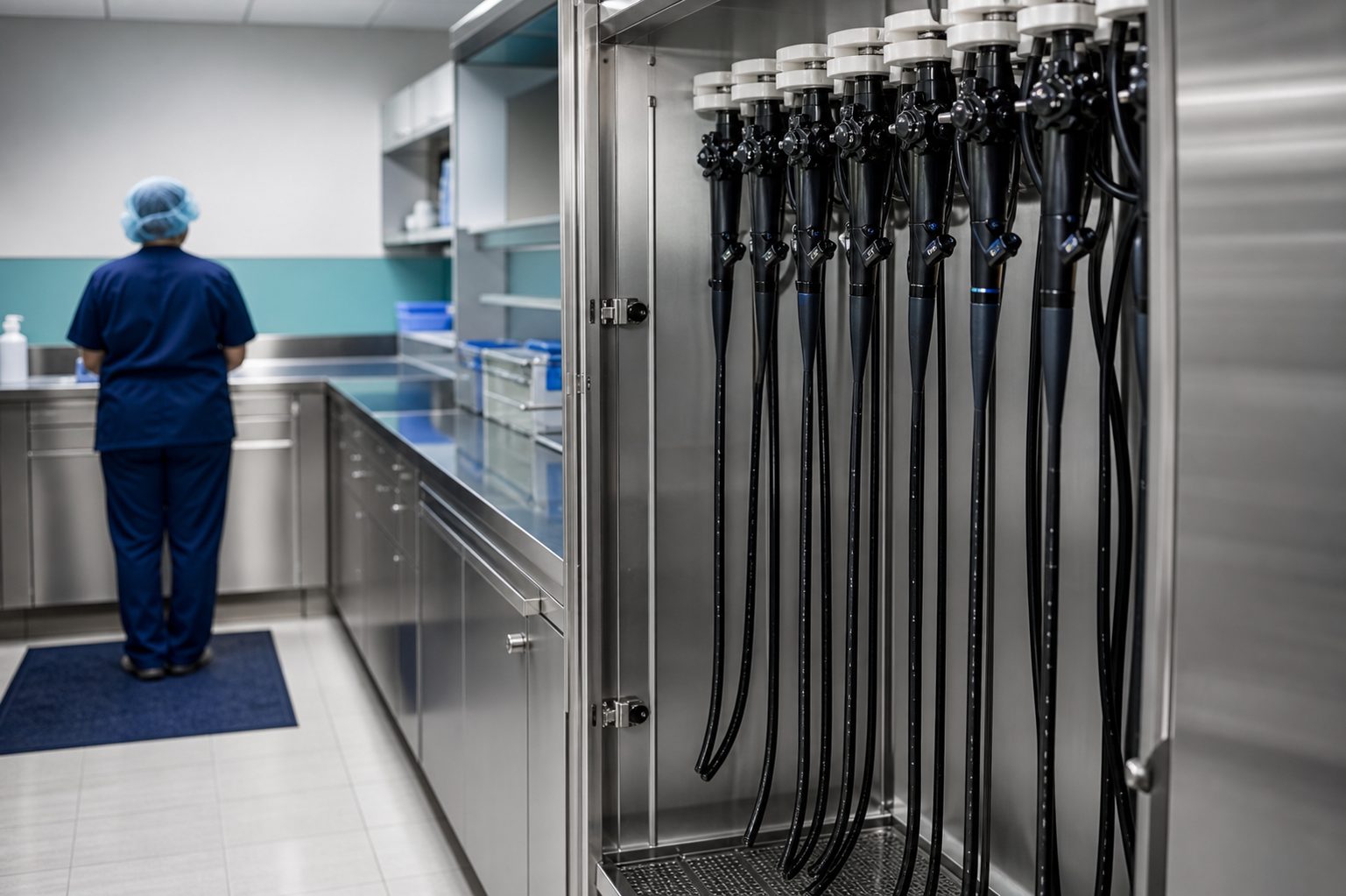
A health system with four campuses in this county does not have one repair problem. It has four, and they rarely look alike. The flagship hospital has a central sterile processing department, spare inventory, and a biomed team with its own asset database. The community hospital it absorbed six years ago still runs the vendor it used before the merger. The outpatient endoscopy suite buys on a credit card. The specialty clinic has a drawer nobody has opened since the last inspection.
What that produces is not a pricing problem. It is a visibility problem. Nobody at the system level can say how many scopes are out for repair this week, which sites are paying twice for the same failure mode, or which serial numbers stopped matching the asset list two mergers ago. Purchasing sees invoices from several vendors and no way to compare them, because none of them describe the work the same way.
Consolidating onto a single account is mostly an administrative fix rather than a clinical one, and that is exactly why it gets deferred. It is also why it pays back quickly once it is done. One point of contact, one document format for biomed, and one place to ask where a device is. The full list of what can sit on that account is on our service lines page.
How Coverage Changes Across the Los Angeles County Map
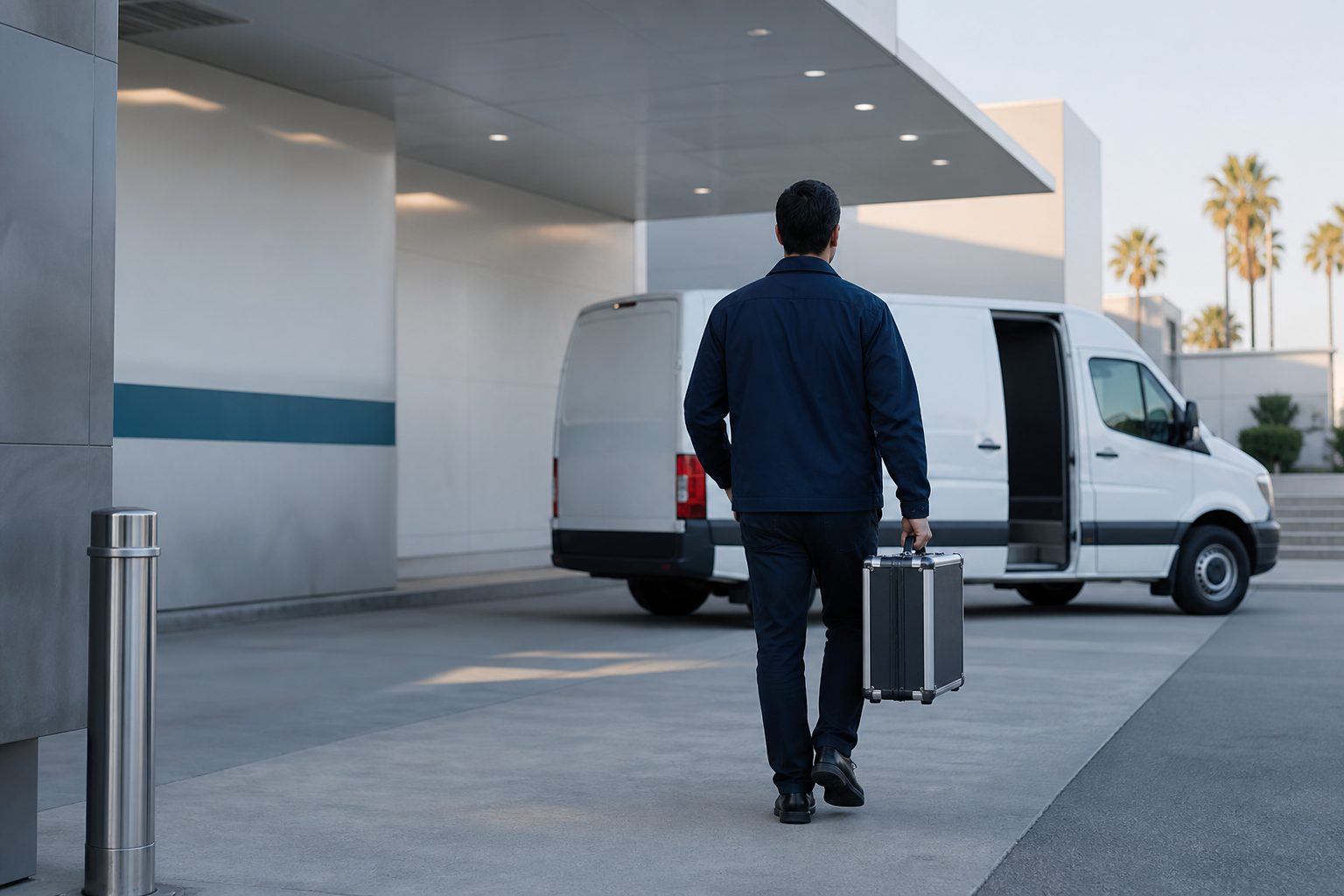
This county is large enough that coverage genuinely differs from one end of it to the other, and pretending otherwise would be useless to anyone planning a route. Our bench sits in the San Fernando Valley. Valley and Westside sites are short runs. The San Gabriel Valley and the Glendale and Pasadena corridor sit on a straightforward loop off the 134 and the 210. The South Bay and the harbor are a longer scheduled run down the 405 and the 110. The Antelope Valley is further still and is normally handled by shipping rather than by van.
That variation matters more to a multi-site group than to a single hospital, because a system usually has sites in three of those bands at once. The practical answer is not to force every site onto the same schedule. It is to set collections where the volume is, add the outlying sites to that trip when the geography allows, and ship in anything a route would slow down.
Receiving differs just as much as distance. A hospital campus wants the courier at a named dock inside a window, with a purchase order number and vendor credentialing already completed. A medical office tower wants a suite number and validated parking. A clinic on a boulevard wants a curbside handoff. Tell us which one each of your sites is when you set the account up, and the route is built around it instead of around an assumption.
- Valley and Westside sites on short local runs
- San Gabriel Valley and the 210 corridor on a scheduled loop
- South Bay and harbor campuses on the 405 and 110 run
- Mail-in shipping for outlying sites a route would slow down
One Collection Route for Several Campuses of Endoscopy Equipment
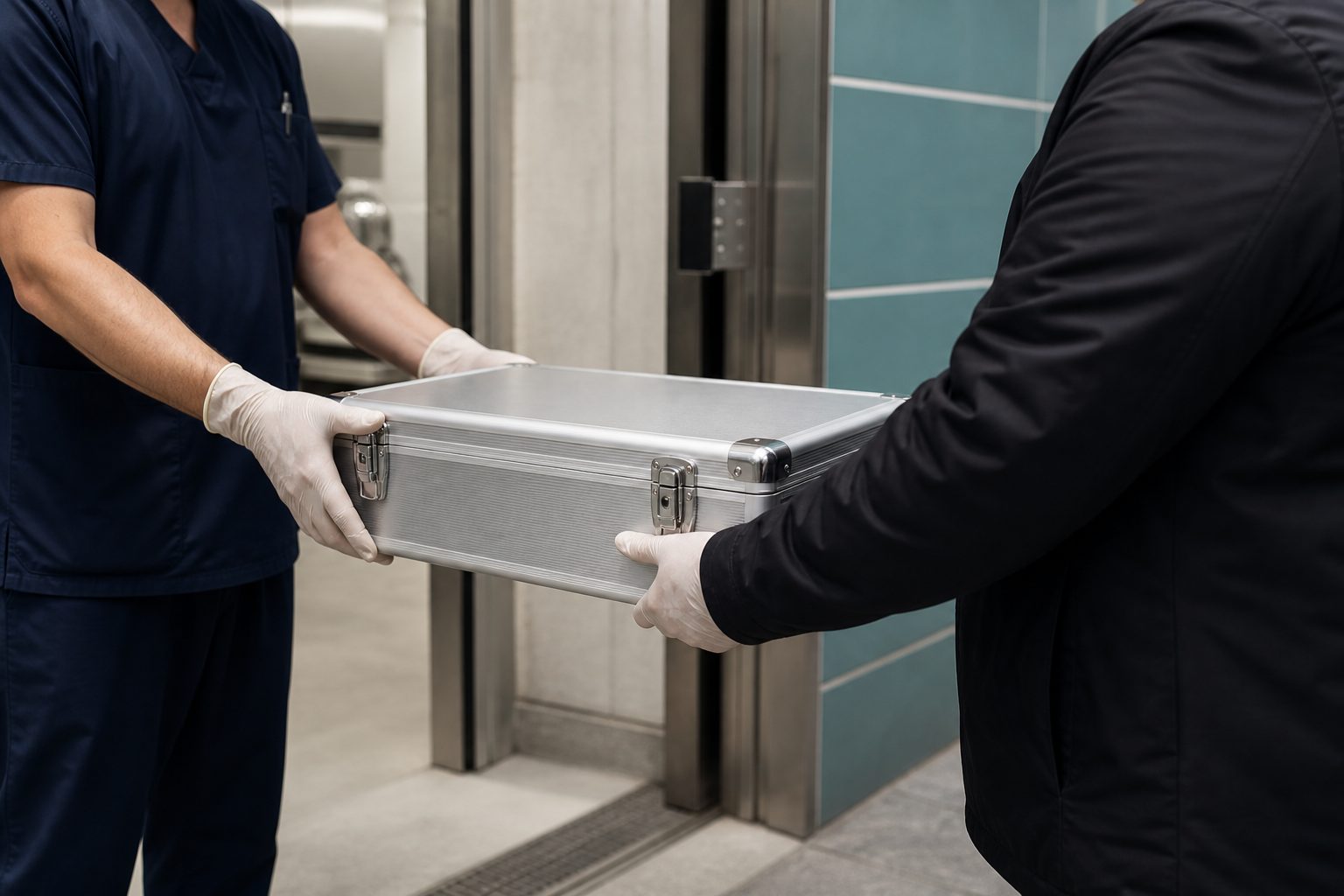
The mechanics are simpler than most groups expect. Devices from several of your sites can travel on one collection, arrive together, and still be quoted separately. Each device is identified by manufacturer, model, and serial number, and the quote is itemized per device, so the endoscopy suite approving a channel repair is not looking at the orthopedics telescope from another campus.
Quotes can be split by location where your accounting requires it, which is usually the sticking point when a group tries to consolidate. A single vendor relationship does not have to mean a single undifferentiated invoice, and if your cost centers are per site, the paperwork follows them.
It also means one trip clears more than scopes. Rigid telescopes, camera heads, couplers, light cables, and instrument trays that need sharpening, tip work, or insulation testing ride along with the flexible inventory. A dim image that turns out to be a fiber optic cable losing half its fibers gets caught in one evaluation rather than three.
Consolidating a Scattered Medical Scope Inventory
Los Angeles County has more hospitals than most states, and a large share of the equipment in them arrived through purchases, donations, departmental transfers, and system consolidations rather than a planned replacement cycle. Inventories here are older and more mixed than a fleet-based pricing model assumes. A flat exchange price set before anyone looks at a device makes sense for identical scopes on a predictable cycle. It makes much less sense for equipment that accumulated over fifteen years across three mergers.
We do not run an exchange pool. The device that leaves your building is the device that comes back, which is what keeps an asset list from drifting further apart from the cabinet. For groups with legacy platforms the original maker no longer supports, that is often the whole reason to call. An end-of-support notice is a decision about a product line, not a verdict on the equipment, and rigid telescope rebuilds and older flexible scope work stay available well after the manufacturer stops answering.
The bench sequence every device goes through, and the testing it has to pass before it goes back, is written out on our repair protocol page. That is normally the first document a system-level biomed director asks for, and it is the same for every site on the account.
Where a Countywide Endoscope Service Account Starts
Start where the volume is rather than trying to move every site at once. Most groups begin with the campus that generates the most repair orders, prove the process on a few devices, and then add the rest as their existing arrangements lapse. There is no contract, no minimum volume, and no commitment to keep sending work, so adding a site costs nothing but a phone call.
The city pages carry the local detail. The central Los Angeles hospital market, the Glendale hospital cluster, and the South Bay campuses around Torrance each describe the facility mix and the pickup pattern in that part of the county.
Groups that run sites down the coast put them on the same agreement. Our Orange County coverage and our San Diego County routes run on the same terms, with one contact for the whole footprint. If a device is already out of rotation for a failed pressure test, start at the fluid invasion page before it goes near a reprocessor again.
Endoscopy Equipment Repair Every Site Can Draw On
GI, pulmonary, urology, orthopedics, general surgery, ENT, and gynecology, handled on one account rather than split across four vendors.
How a county account works
How a Countywide Surgical Scope Repair Account Works
You approve the work at the quote, device by device and site by site. If you decline, the device comes back and you owe nothing.
Tell us what failed
Send the manufacturer, model, and what you are seeing. A photo of the damage helps but is not required.
We collect the scope
Courier pickup across Southern California, or ship the device in to our bench from anywhere in the country.
You get a written quote
We evaluate the device, document the failure, and price the repair. Nothing proceeds until you approve it.
Repaired, tested, returned
The device is repaired, leak and function tested, and returned with documentation for your records.
Questions we get
County Coverage Questions From Materials Management
We run six sites across the county. Can they all sit on one account?
Does every site get the same coverage, or does it depend where they are?
Can devices from several campuses travel on one collection?
Do we have to move every site at once to get the countywide arrangement?
Our older campus has equipment the manufacturer no longer supports. Is that a problem?
Each of our sites needs its own purchase order. Does that break the arrangement?
Surgical Scope Repair in the Neighboring Counties
The same multi-site agreement runs south through Orange County and San Diego County.
Open a Los Angeles County Scope Service Account
Tell us how many sites you run and where they sit. We will map the collection and quote every device in writing before anyone opens one.
Monday to Friday, 8:00 AM to 5:00 PM Pacific
Saturday and Sunday, closed
Mail-in repairs received any day
Serving Southern California with pickup and delivery, and the rest of the country by mail-in.